OpenAI Will Shut Down GPT-4o and GPT-4.1 in Its API on 14 January 2027
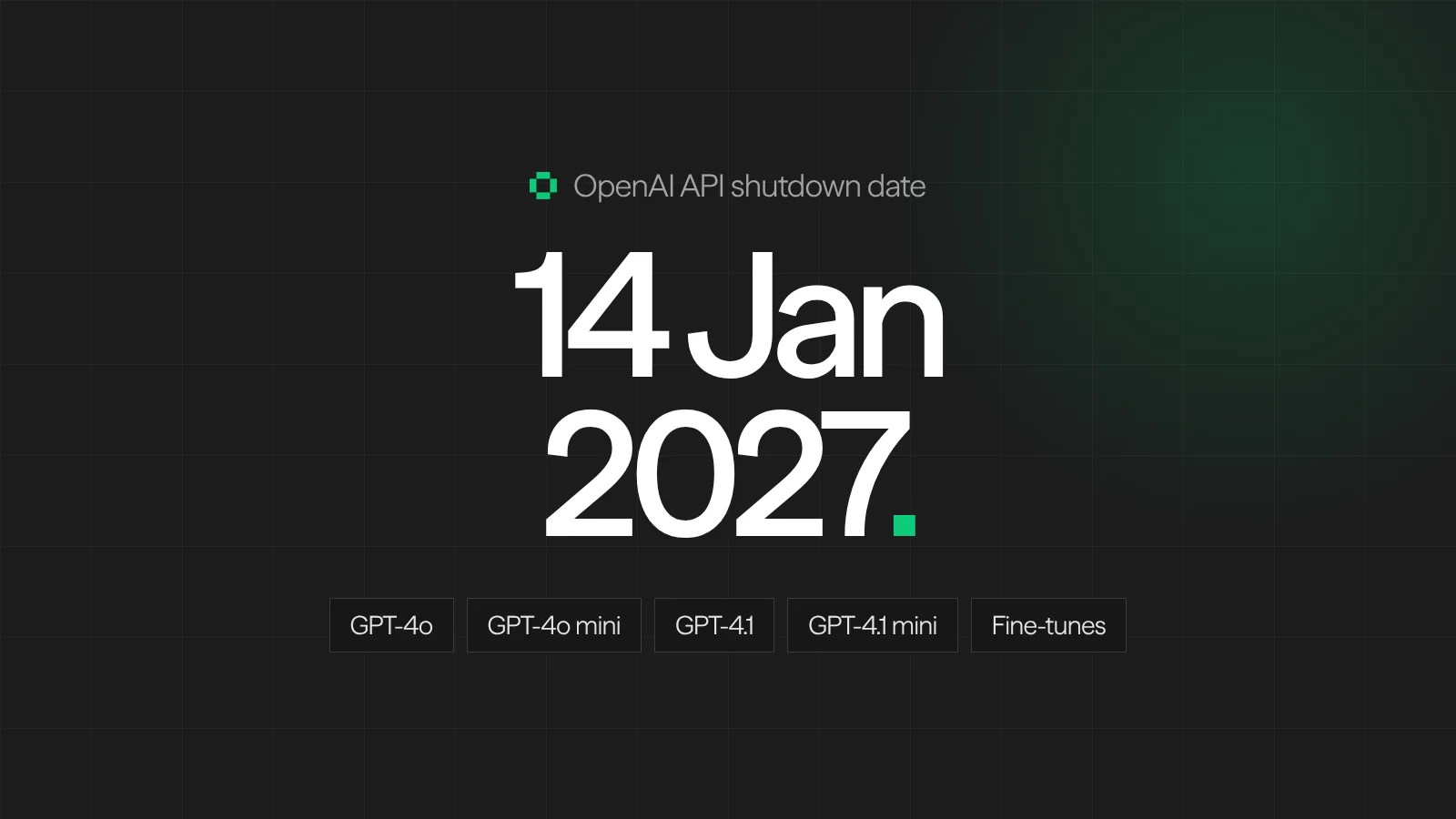
OpenAI has set 14 January 2027 as the date GPT-4o, GPT-4o mini, GPT-4.1 and GPT-4.1 mini stop working in its API, fine-tuned versions included. Here is what is affected, the other dates on the same list, and how to move a production system without surprises.
- Written by
 Muhammad Usman Siddiqui
- Published
- Format
- News
- Markets
- Global
- Reading time
- 3 min
Dates to act on
- tts-1, tts-1-hd and gpt-4o-mini-tts shut down
- Fast and priority tiers end for GPT-5.2 and GPT-5.4 with EU data residency
- GPT-4o, GPT-4o mini, GPT-4.1 and GPT-4.1 mini shut down, fine-tunes included
- gpt-5.1, gpt-5.4-nano and gpt-5.3-codex shut down
Key takeaways
- GPT-4o, GPT-4o mini, GPT-4.1 and GPT-4.1 mini snapshots stop working in the OpenAI API on 14 January 2027. OpenAI recommends GPT-6 Luna as the replacement.
- Fine-tuned versions of those models shut down on the same date, so a fine-tune needs a plan of its own.
- Older voice models (tts-1, tts-1-hd and gpt-4o-mini-tts) go earlier, on 6 January 2027.
- Treat the switch as a release, not a config change. Test the new model on your own questions before you move traffic.
What OpenAI announced
On 14 October 2026 OpenAI added these models to its deprecations page with a shutdown date of 14 January 2027.[1]
| Model | Snapshots listed | Shutdown | Suggested replacement |
|---|---|---|---|
| GPT-4o | gpt-4o-2024-08-06, gpt-4o-2024-11-20 | 14 January 2027 | gpt-6-luna |
| GPT-4o mini | gpt-4o-mini-2024-07-18 | 14 January 2027 | gpt-6-luna |
| GPT-4.1 | gpt-4.1-2025-04-14 | 14 January 2027 | gpt-6-luna |
| GPT-4.1 mini | gpt-4.1-mini-2025-04-14 | 14 January 2027 | gpt-6-luna |
The page also says fine-tuned versions of the listed models follow the same schedule as their base models.[1]
Other dates on the same list
GPT-4o is the headline, but it is not the first date on the list. These also matter if you run AI in production:[1]
- 6 January 2027: tts-1, tts-1-hd and gpt-4o-mini-tts shut down. The suggested replacement is gpt-realtime-2.1-mini. Check this first if you run a voice product.
- 11 January 2027: GPT-5.2, GPT-5.4 and GPT-5.4 mini stop supporting the fast and priority service tiers when used with EU data residency. The default tier keeps working.
- 1 April 2027: gpt-5.1, gpt-5.4-nano and gpt-5.3-codex shut down, with GPT-6 Sol or GPT-6 Luna suggested in their place.
OpenAI is also pushing newer, cheaper models. It prices GPT-6.1 Terra at $1 per million input tokens and $5 per million output tokens, and claims it matches GPT-6 Astra on its own agent benchmark at a tenth of the price per token.[2] Those are OpenAI's figures, so test them on your own work.
Who this affects
Any system that names one of these models in code or configuration. In our experience the model name is rarely in one place. It sits in the main app, in background jobs, in evaluation scripts, in a prompt library and sometimes in a no-code tool someone set up two years ago. Fine-tuned models are the hardest case, because the training data and the reasons behind it may no longer be at hand.
How to move without surprises
- Find every call. Search code, config, scheduled jobs and third-party tools for the model names and snapshot IDs above. List your fine-tunes separately.
- Build a test set from real traffic. Take 50 to 200 real requests with answers you know are right. Include the hard ones and the ones that broke before.
- Compare old and new side by side. Check accuracy, output format, refusals, speed and the cost of the same work. Our LLM evaluation guide shows how we set this up.
- Decide what to do with each fine-tune. Fine-tune a newer model, or check whether a stronger base model with better prompts or retrieval now does the job without one.
- Roll out in steps. Send a small share of traffic to the new model first, watch the numbers, then move the rest well before 14 January.
- Stop hard-coding model names. Put the model choice behind one setting, so the next retirement is a test run and a config change, not a hunt through the codebase.
If you are choosing between several replacements, our guide on choosing AI models covers frontier versus open-weight models, routing and cost.
Frequently asked questions
On 14 January 2027. OpenAI announced the date on 14 October 2026. It covers the GPT-4o snapshots gpt-4o-2024-08-06 and gpt-4o-2024-11-20, GPT-4o mini, GPT-4.1 and GPT-4.1 mini.
OpenAI recommends GPT-6 Luna. That is a starting point, not a guarantee. Run the new model against a set of your own real questions and compare the answers, the output format, the speed and the cost before you switch.
Fine-tuned versions follow the same shutdown date as their base model, so a fine-tune on GPT-4o or GPT-4.1 also stops on 14 January 2027. You either fine-tune a newer model or find out whether better prompts or retrieval now do the job without a fine-tune.
This notice is about the API, which is what your own software calls. It does not describe changes to the ChatGPT app.
Sources
- Deprecations, OpenAI API documentation. Checked 22 Nov 2026.
- Introducing GPT-6.1 Terra, OpenAI. Checked 22 Nov 2026.
Figures and claims come from the announcements above and are the vendors' own unless stated. Spotted an error? Tell us at hello@edgefirm.io.
Where EdgeFirm can help
Read next
- Enterprise AI News, October 2026: Cheaper Models, Agents With Job Titles and Hard DeadlinesMonthly overview, October 2026
- EU AI Act: Machine-Readable Marking of AI Output Is Due by 2 December 2026News
- Choosing AI Models: Open Source LLMs, Frontier Models, Thinking and CostGuide
- LLM Evaluation: Evals, Tracing and Fact-Checking for Production AgentsGuide
- How to Reduce LLM Costs Without Sacrificing QualityBlog
- All EdgeFirm NewsHub

Written by
Lead AI Architect
Usman has spent 8+ years building AI and machine learning systems for enterprises. He specializes in LLM architectures, RAG systems, and the data pipelines that keep production AI accurate.