EU AI Act: Machine-Readable Marking of AI Output Is Due by 2 December 2026
The Digital Omnibus on AI is now law. It gives providers of generative AI systems already on the EU market until 2 December 2026 to mark AI output in a machine-readable way, and moves the high-risk deadlines to December 2027 and August 2028. What changed and what to check now.
- Written by
 Muhammad Usman Ali
- Published
- Format
- News
- Markets
- European Union, UK, Global
- Reading time
- 3 min
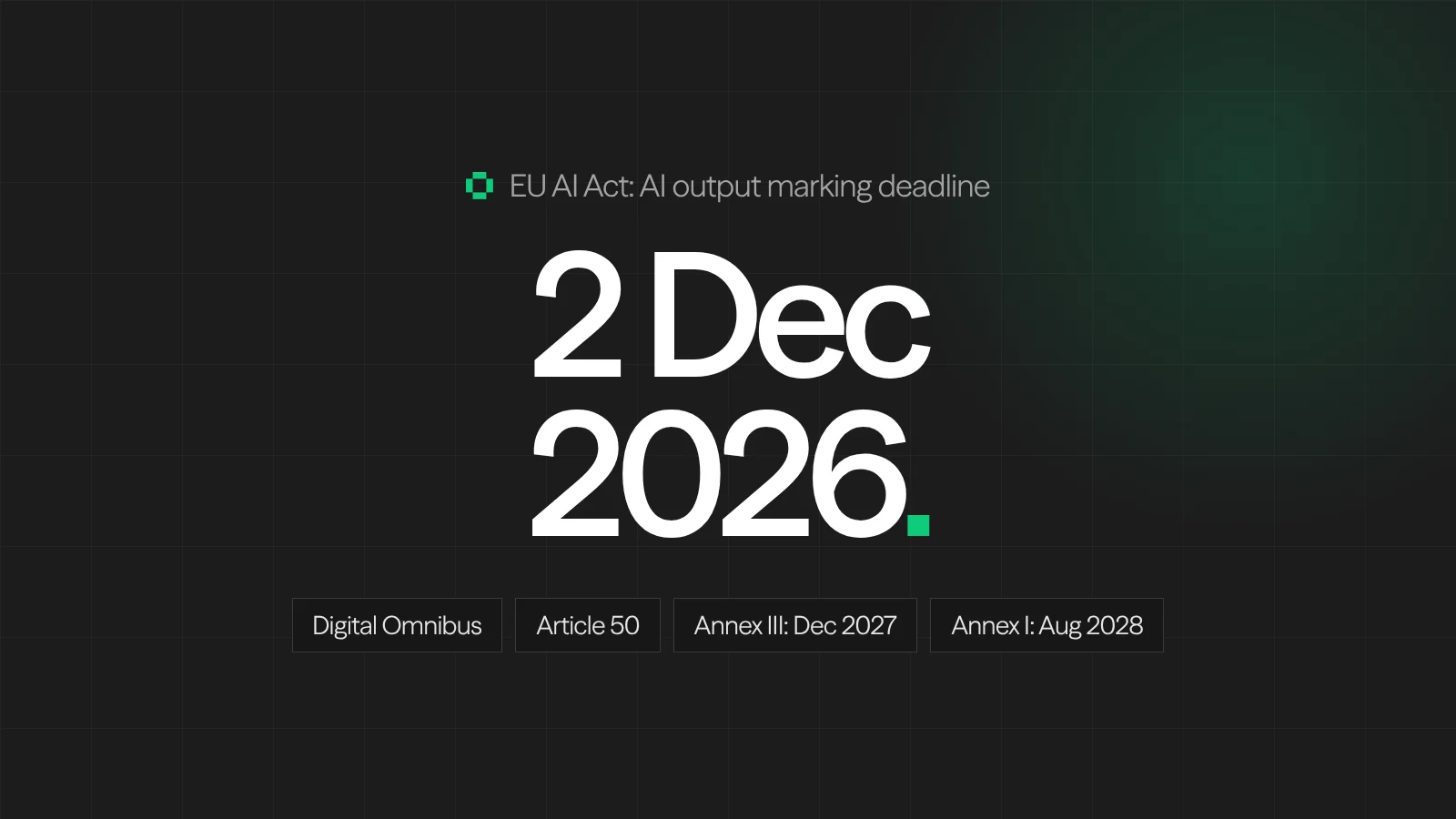
Dates to act on
- AI output marking due for systems on the EU market before 2 August 2026
- Each EU country must have at least one AI regulatory sandbox
- High-risk rules apply to stand-alone Annex III systems
- High-risk rules apply to AI in Annex I regulated products
Key takeaways
- The Digital Omnibus on AI was published in the EU Official Journal on 24 July 2026 and entered into force on 27 July 2026.
- Providers of AI systems that generate audio, images, video or text must mark that output in a machine-readable format. Systems placed on the EU market before 2 August 2026 have until 2 December 2026.
- The other Article 50 duties, such as telling people they are talking to an AI system, have applied since 2 August 2026.
- High-risk rules moved to 2 December 2027 for stand-alone Annex III systems and 2 August 2028 for AI built into Annex I products.
What changed this year
The Digital Omnibus on AI is the first formal set of amendments to the EU AI Act. The Council and Parliament reached a provisional deal on 7 May 2026.[3] It was published in the Official Journal on 24 July 2026 as Regulation (EU) 2026/1744 and entered into force on 27 July 2026.[1]
| Obligation | Date |
|---|---|
| Most Article 50 transparency duties, such as telling people they are dealing with an AI system | 2 August 2026 |
| Machine-readable marking, for systems placed on the market on or after 2 August 2026 | From 2 August 2026 |
| Machine-readable marking, for systems placed on the market before 2 August 2026 | 2 December 2026 |
| High-risk rules for stand-alone Annex III systems | 2 December 2027 (was 2 August 2026) |
| High-risk rules for AI in Annex I regulated products | 2 August 2028 (was 2 August 2027) |
Dates from White & Case and Lewis Silkin.[1][2]
Who has to mark AI output
The marking duty sits with providers of AI systems that generate synthetic audio, image, video or text content. They "must mark outputs in a machine-readable format", in Lewis Silkin's summary.[2] Hogan Lovells describes this as the Article 50(2) obligation.[3]
Large vendors are already moving. On 5 October 2026 OpenAI said it would add an invisible watermark to eligible ChatGPT and Codex text in the EU, rolling out over the following weeks. In its API, text watermarking stays off by default, and customers can opt in for select models.[4]
The other changes worth knowing
- AI literacy is softer. Providers and deployers must take measures that support AI literacy among staff. The law no longer asks for a "sufficient level" for each person. Documented training is the practical expectation.[2]
- New bans. Apps that create non-consensual intimate images ("nudifiers") and child sexual abuse material are now prohibited practices.[2]
- More room to test bias. Special category personal data can be processed to detect bias across all AI systems, under a strict necessity test.[2]
- Sandboxes and support. National authorities have until 2 August 2027 to set up at least one AI regulatory sandbox. Support measures, including priority sandbox access, now reach small mid-cap companies as well as SMEs.[2]
What to check before 2 December
- List where AI output leaves your system. Emails, documents, images, chat replies, reports and API responses to other companies.
- Ask counsel whether you are a provider or a deployer for each system you place on the EU market.
- Check what your model vendor marks. Find out which outputs, which plans, and whether the API needs you to opt in.
- Close the gaps in your own pipeline. If your system generates content itself, add machine-readable marking and log it, so you can show it works.
- Keep the Article 50 basics in place. People should know when they are dealing with an AI system. That duty has applied since August.
If you need help mapping this to your own systems, our privacy-compliant AI consulting team turns each rule into a concrete control, documents it and hands your team the logs and tests to show it.
Frequently asked questions
It is the date by which providers of generative AI systems that were already on the EU market before 2 August 2026 must mark AI-generated audio, images, video and text in a machine-readable format. Systems placed on the market from 2 August 2026 onward had to do this from day one.
Yes. Rules for stand-alone high-risk systems listed in Annex III now apply from 2 December 2027 instead of 2 August 2026. Rules for AI built into products covered by Annex I now apply from 2 August 2028.
The AI Act applies to AI systems placed on the EU market or used in the EU, wherever the company is based. A UK, US or Gulf company that sells a generative AI product to EU users should check whether it counts as a provider. Ask your counsel, because the answer depends on how the system is built and sold.
Often the model vendor marks its own output. Some vendors are already doing it, for example OpenAI for ChatGPT and Codex text in the EU. If you build your own product on top and place it on the EU market, check with counsel whether you are the provider of that system, and check what the vendor's marking covers in your setup. OpenAI, for one, keeps it off by default in its API.
Sources
- EU AI Omnibus enters into force, amending the AI Act, White & Case, 4 Aug 2026. Checked 22 Nov 2026.
- The Digital Omnibus on AI enters into force today, Lewis Silkin, 27 Jul 2026. Checked 22 Nov 2026.
- EU legislators agree to delay for high-risk AI rules, Hogan Lovells, 7 May 2026. Checked 22 Nov 2026.
- Text provenance in the EU, OpenAI, 5 Oct 2026. Checked 22 Nov 2026.
Figures and claims come from the announcements above and are the vendors' own unless stated. Spotted an error? Tell us at hello@edgefirm.io.
Where EdgeFirm can help
Read next

Written by
Co-Founder & Director of Engineering
Usman brings 8+ years of experience building enterprise systems. He specializes in system architecture, DevOps, and data pipelines that power production AI.