How to Build a Private AI Chatbot for Internal Company Documents
What private really means, how permissions work, what to test, and what it costs to deploy.

Co-Founder & Director of Engineering
· 5 min read

On this page · 10 sections
- 01What "private" actually means
- 02How the system works
- 03Why permissions decide the whole project
- 04What a private AI chatbot for company documents needs first
- 05Cost and timeline
- 06Where the model should run
- 07What to test before you trust it
- 08What it will not do
- 09Making people actually use it
- 10Build a private enterprise AI assistant
The request usually arrives the same way. Somebody pastes a contract into a public chatbot, legal finds out, and suddenly there is urgent interest in building a private AI chatbot for company documents instead.
That instinct is right. But "private" means several different things. The version you pick changes your design, your budget, and what your security team will sign off.
So here is what the options actually are.
What "private" actually means
Three levels usually get discussed. Because nobody says which one they mean, people talk past each other.
- No training on your data. The big API vendors put this in the contract on business plans. Your prompts do not feed their models. For most firms, that is enough.
- Your own cloud. The model runs inside your Azure, AWS, or Google account. Data stays inside your boundary, under deals and audit rules you already have. This clears the bar in most regulated fields.
- Fully self-hosted. Open-weight models on your own hardware, with no calls out at all. Needed for classified work, or strict rules on where data may sit. Also the priciest choice by a wide margin.
Pick the lowest level that meets your duties. Teams often over-spec here. Then they pay two or three times more for a promise nobody asked for.
How the system works
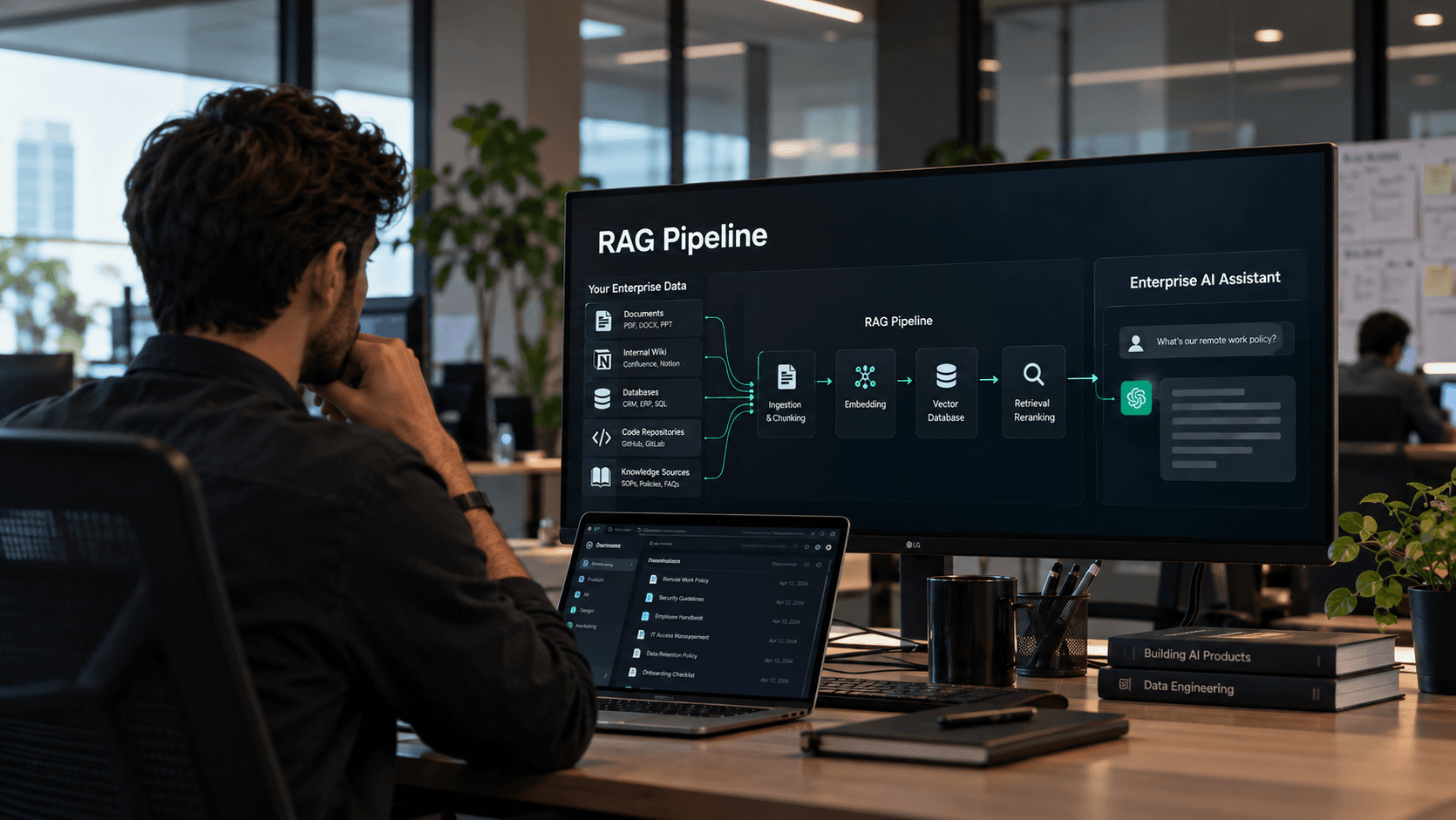
A private AI chatbot for company documents does not memorize your files. It searches for them.
A user asks something. The system searches your indexed content. It pulls the passages that match, then hands them to a model along with the question. The model answers from that text, and cites where each claim came from.
Your files stay where they are. Nothing is baked into the model, so editing a file changes the answers right away. Just as important, an answer with no citation is a red flag, not a feature.
Why permissions decide the whole project
Above all, this is what separates a demo from something you can actually deploy.
Your finance folder, HR records, and board papers all have different readers. A bot that searches all of it and answers anyone is a data breach with a friendly face.
So the rules must apply at search time, per user, against the identity system you already run. Filtering the output later is not enough. By then the model has seen the text.
Ask every vendor how they do this. The OWASP Top 10 for LLM Applications ranks leaked data among the top risks. Search that ignores access rules is the usual cause.
What a private AI chatbot for company documents needs first
Four things, and none of them are technical. Still, each one takes real time.
First, a clear content set. Start with one team, or one document type. Not everything you own.
Second, a ruling on which version is the real one. Most firms hold several copies of the same policy. The bot will happily quote the stale one.
Third, your access rules, written down. If they live only in people's heads, start there.
Fourth, a named owner for after launch. Content keeps changing, and accuracy slips when nobody is watching.
Cost and timeline
A focused internal assistant over one content set, with one or two integrations, runs three to four months at $40,000 to $60,000.
A wider rollout costs more. Access rules across several systems, Slack or Teams delivery, and compliance controls put you in the $70,000 to $100,000 band over four to five months. Most of our custom LLM and RAG builds land there.
Self-hosting adds a lot to both numbers. You take on the GPUs, the model ops, and the staff to run them. So choose that path only when the rule forcing it is real.
Inference runs on top, and maintenance costs 15% to 20% of the build annually.
Where the model should run
You have two sensible options, and the choice follows your compliance level.
For most firms, a commercial API on a business plan is the right call. Quality is high, there is nothing to operate, and the contract covers data use. Costs scale with volume, which suits uneven demand.
For stricter cases, an open-weight model inside your own cloud works well. Quality is close enough now for document questions. However, you take on the GPU bill and the people to run it.
In practice, a private AI chatbot for company documents rarely needs the frontier model. Document questions are not the hard end of the task.
What to test before you trust it
First, write fifty real questions with known answers. Then check three things in particular.
Naturally, does it refuse when the answer is not in your documents? A system that invents plausible policy is worse than no system.
Does it respect access rules? Test with accounts at different levels. Check that a limited user cannot pull restricted text out of it with a clever question.
Does it cite well? Follow the links. Confident answers that point at the wrong paragraph are a known failure, and a fast way to lose trust.
What it will not do
Set expectations early, because a few disappointments are predictable.
It will not reason across your whole archive. Ask it to compare every contract signed since 2020 and it will answer from a handful of passages, not all of them. That is a different kind of system.
It will not fix bad source material. Vague policies produce vague answers.
It will also not replace your search tool on day one. Most teams run both for a while, and that is fine.
A private AI chatbot for company documents is very good at one thing: answering a specific question from text that exists somewhere in your files. Scope it to that and it earns its keep.
Making people actually use it
Put the assistant where work already happens. A Slack or Teams version gets used several times more than a web portal, purely because it saves a step.
Then seed it with the questions your HR, legal, or support teams field most often. Early wins build the habit. Habit is what makes the spend pay back.
Watch month one closely. The questions will differ from what you guessed. They also tell you exactly what to index next. Our 4-Month AI Framework sets out this rollout order, plus the build-versus-buy matrix.
Build a private enterprise AI assistant
The right architecture for a private AI chatbot for company documents depends on your compliance position, your identity model, and the content you actually need answered.
Book a 30-minute call with our founders. You will leave with a recommended approach, a timeline, an investment range, and an ROI estimate. No sales pitch.
Topics
- private AI chatbot
- AI chatbot for company documents
- RAG
- Enterprise AI security

Written by
Co-Founder & Director of Engineering
Usman brings 8+ years of experience building enterprise systems. He specializes in system architecture, DevOps, and data pipelines that power production AI.
Work with EdgeFirm
Ship this in your stack in 4 to 5 months.
A 30-minute call with the founders who will write your code. Fixed price, full IP ownership, no offshore handoff.
Book Strategy CallOr get the 4-Month Framework