AI Proof of Concept vs Production AI: What Should Enterprises Build First?
What each one actually proves, when a PoC is worth the weeks, and the thin production slice most teams should build.

Co-Founder & Director of Engineering
· 5 min read
On this page · 10 sections
- 01What each one is for
- 02AI proof of concept vs production: five real differences
- 03When a proof of concept earns its place
- 04When you should skip it
- 05What a PoC costs you
- 06The pilot trap
- 07The middle path most teams should take
- 08How to decide this week
- 09One rule that prevents most of the pain
- 10Plan a production-ready project
The AI proof of concept vs production question usually arrives disguised as a budget decision. Someone suggests starting small. It sounds prudent, and often it is.
But a proof of concept and a production system answer completely different questions. Building the wrong one first is how organizations spend six months proving something they already knew.
So here is how to tell which you actually need.
What each one is for
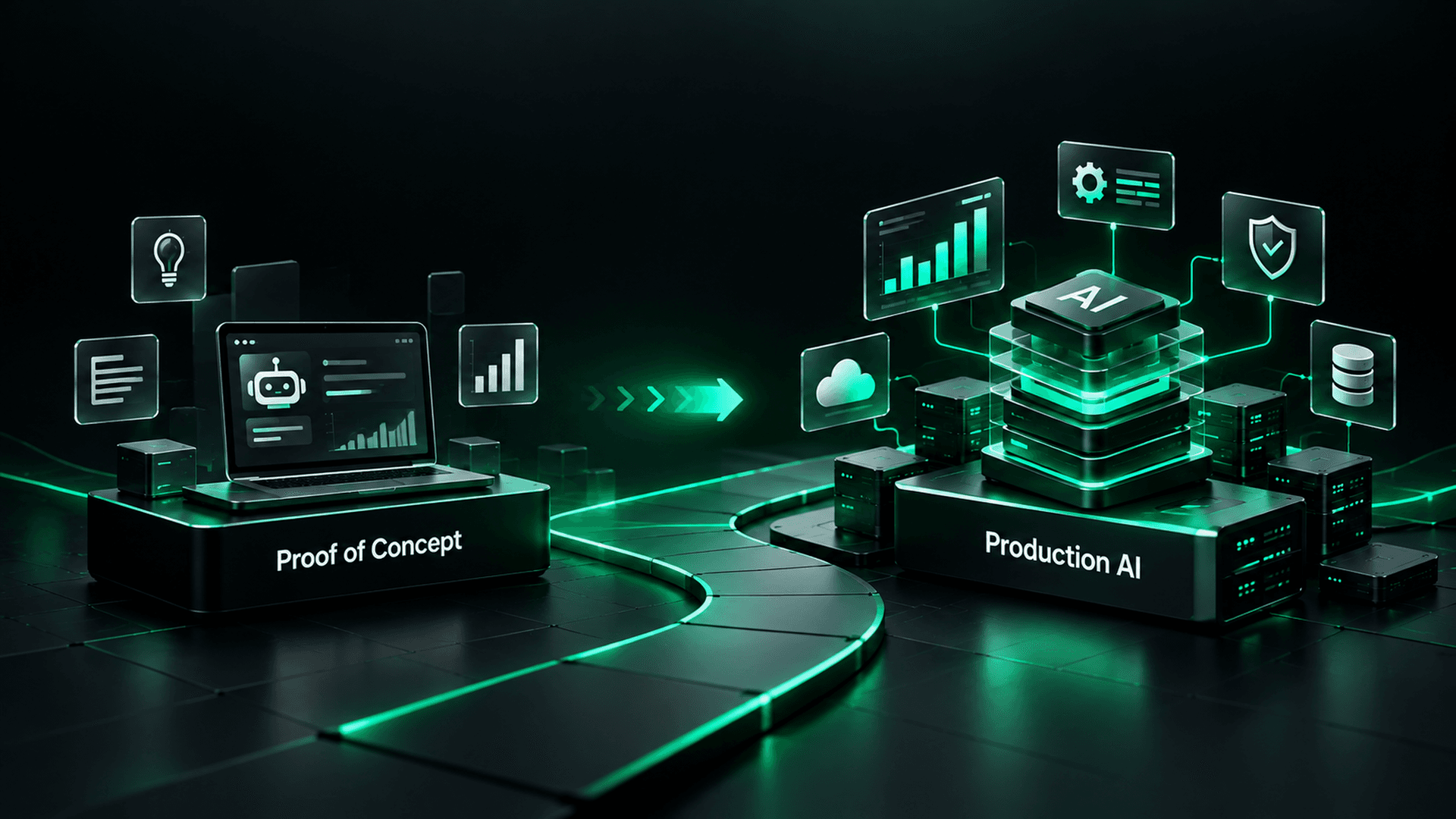
A proof of concept answers a technical question. Can a model read our contracts accurately enough to be useful? Will retrieval work on this messy document set? It runs on sample data, has no real users, and takes four to six weeks.
A production system answers a business question. Does this save money at scale, reliably, inside our security perimeter? It runs on live data, serves real users, and takes four to five months.
Notice that the second question includes the first. That is the heart of the matter.
AI proof of concept vs production: five real differences
In the AI proof of concept vs production comparison, five things change.
- Data. A PoC uses a curated sample. Production faces everything, including the malformed records and the edge cases nobody documented.
- Integration. A PoC usually has none. Production is mostly integration, which is where forty to sixty percent of the effort goes.
- Failure handling. A PoC can be wrong. Production needs fallbacks, escalation paths, and monitoring that tells you when quality drifts.
- Security. A PoC often runs outside your compliance boundary. Production sits inside it, so SOC 2, HIPAA, or GDPR obligations shape the architecture.
- Ownership. A PoC needs nobody. Production needs a named owner, or it degrades quietly over a year.
Because of that gap, a successful PoC does not shorten the real build as much as people hope. It saves three to four weeks. It does not save three months.
When a proof of concept earns its place
There are four situations where we recommend one without hesitation.
First, genuine technical uncertainty. If nobody knows whether a model can handle your particular documents, spend four weeks finding out.
Second, unusual or very messy data. Handwritten forms, obscure formats, and multilingual records all deserve a test before a full commitment.
Third, internal skepticism. Sometimes a working demo is the only thing that unlocks a budget conversation, and that is a legitimate reason.
Fourth, a novel use case. If nobody in your industry has done this, the risk is real and worth reducing cheaply.
When you should skip it
Skip the PoC when the pattern is well established. Document extraction, internal knowledge search, ticket triage, and retrieval over your own content are solved problems now. A PoC will tell you they work, which everyone already knew.
Skip it when your real risk is integration or adoption rather than model capability. Most enterprise projects fail on those two, and a PoC tests neither.
Skip it when you have already run one. Two proofs of concept in a row is a sign that the organization is avoiding a decision, not reducing risk.
What a PoC costs you
Money is rarely the issue. A short proof of concept runs $15,000 to $30,000, which most teams can approve without a board paper.
Time is the real cost. Six weeks to build it. Two weeks to review it. Then another month while the budget for the real thing works its way through. So a "quick" PoC often adds a full quarter before any value reaches a user.
That delay matters more than it looks. Sponsors move on. Priorities shift. A project that could have shipped in month four now ships in month eight, if it ships at all.
The pilot trap
This is the expensive failure mode, and it is common. MIT's NANDA study found roughly 95% of enterprise generative AI pilots produced no measurable impact on the P&L.
Those pilots did not fail because the models were weak. They failed because a demo built on sample data cannot be promoted to a production system. The architecture is different, the security posture is different, and the code was never written to be maintained.
So the team rebuilds from scratch, months later, with less political capital than they started with. The AI proof of concept vs production decision was never really made. It was simply deferred until it became expensive.
The middle path most teams should take
There is a better option than either extreme. Build a thin production slice.
Take the narrowest useful version of the real system. One workflow, one integration, real data, real users, proper security. Ship it in three to four months, which is roughly what our focused build tier covers.
You learn everything a PoC would teach you about model quality. In addition, you learn what a PoC cannot show. Is your data usable at scale? Is integration harder than expected? Do people actually adopt the thing?
Crucially, you keep the code. It was built to production standard from the first commit, so nothing gets thrown away.
That approach is what our 4-Month AI Framework is built around, including the build-versus-buy matrix and the five reasons projects stall.
How to decide this week
Ask one question: what are we actually unsure about?
If the honest answer is "whether the model can do this at all", run a short proof of concept with a defined pass mark agreed in advance. Write down what success looks like before you start, or you will argue about the result afterwards.
If the answer is "whether this delivers value in our environment", skip straight to a thin production slice. That is the case for most enterprises, most of the time.
And if the answer is "we are not sure what problem we are solving", neither option helps yet. Start with the process and the baseline instead. Our AI consulting engagements usually begin exactly there.
One rule that prevents most of the pain
Whatever you choose, agree the pass mark in writing before work starts.
For a proof of concept, that means a number. Ninety percent extraction accuracy on a hundred sampled contracts, say, judged by a named reviewer. Without it, the result becomes a matter of opinion, and opinion favors whoever is loudest in the room.
For a production slice, the pass mark is a business figure. Hours saved, errors avoided, cycle time reduced, measured against the baseline you captured beforehand.
Plan a production-ready project
The AI proof of concept vs production choice gets much easier once someone looks at your data, your systems, and your compliance position.
Book a 30-minute call with our founders. You will leave with a recommendation, a timeline, an investment range, and an ROI estimate. No sales pitch.
Topics
- AI proof of concept vs production
- AI proof of concept
- Production AI
- AI pilot

Written by
Co-Founder & Director of Engineering
Usman brings 8+ years of experience building enterprise systems. He specializes in system architecture, DevOps, and data pipelines that power production AI.
Work with EdgeFirm
Ship this in your stack in 4 to 5 months.
A 30-minute call with the founders who will write your code. Fixed price, full IP ownership, no offshore handoff.
Book Strategy CallOr get the 4-Month Framework